http://www.makepovertyhistory.org

Monday, May 14, 2007

[PDF] A Manifesto For Mavericks
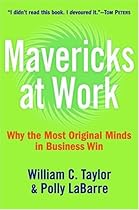
Bill Taylor and Polly Labarre are the authors of Mavericks at Work a book that asserts an n irresistible mantra for social entrepreneurs;
In an age of hyper-competition and nonstop innovation, the only way to stand out from the crowd is to stand for something truly original.
Bill is the co founder and founding editor of Fast Company. Polly was one of the original core contributors to the same magazine.

Aside from the widely available book, Bill and Polly created a manifesto at ChangeThis - see A Manifesto For Mavericks.

We think their message to business isn't the only suitable audience. Here are 10 questions they think should be asked:
  • Is there a distinctive and disruptive sense of purpose that sets you apart from the competition?
    The best companies are the ones that stand for the most original and compelling ideas. What ideas are you and your company fighting for?


  • Can you be provocative without provoking a backlash?
    There’s a difference between challenging the status quo and inviting retribution from rivals that are bigger, richer, and more ruthless than you. One key test of any would-be disruptor is whether he or she can also be a convincing diplomat.


  • If your company went out of business tomorrow, who would miss you and why?
    We first heard this question from advertising maverick Roy Spence, who tells us that he got it from Jim Collins of Good to Great fame. Whatever the original source, the question is as profound as it is simple — and worth taking seriously.


  • Are you the kind of person that other smart people want to work with?
    If you expect outsiders (or even colleagues) to share their best ideas with you, then don’t be surprised when they expect something in return. It can be money, it can be recognition, but more often than not, what draws people into open-source projects is the chance to push themselves and develop their skills.


  • Can you make innovation fun?
    Ideas are serious business, but if you’re working to tap the brainpower of outside-the mainstream contributors, then you have to work to keep your open-source project colorful, dramatic, and energetic.


  • Do you treat different customers differently?
    If your goal is to establish a psychological contract with customers, then almost by definition you won’t appeal to all customers. One test of how committed a company is to its most important customers is how fearless it is about ignoring (even offending) customers who aren’t central to its mission. Not all customers are created equal.


  • Why should great people join your organization?
    The best leaders understand that the best rank-and-file performers aren’t motivated primarily by money. Great people want to feel like impact players inside their organizations. Great people want to be surrounded with and challenged by other great people. Put simply, great people want to feel like they’re part of something greater than themselves. Does your company give them that chance?


  • Do you know a great person when you see one?
    In organizations that are serious about competing on talent, who you are as a person is as important as what you know at a moment in time. That is, character counts for as much as credentials. Do you know how to conduct a character test?


  • Does your organization work as distinctively as it competes?
    It’s a simple question with huge implications for productivity and performance. Leaders who are determined to elevate the people factor in business understand that the real work begins once talented people walk through the door. HR maverick John Sullivan says it best: “Stars don’t work for idiots.”


  • Are you learning as fast as the world is changing?
    We first heard this question from Gary Hamel, the world-renowned strategy guru, and it’s the ultimate challenge for any executive or entrepreneur. The best leaders we’ve met, regardless of their age, experience, or personal style, have all been insatiable learners. In a business environment that never stops changing, you can never stop learning.

---------------------

Interested in learning more about social enterprise? Take a browse through the Vancouver Social Enterprise Book Store (Vancouver | United Kingdom | United States) and see what other social entrepreneurs recommend reading.

del.icio.us Tags for information about: for:vsef, Social Enterprise, Management, ChangeThis

--------------------

Labels: ,


Continue reading this item ... AddThis Social Bookmark Button

Friday, December 08, 2006

[Opportunity] Room to Read

We're fans of John Wood and, his organization, Room to Read.

The organization was high on our favourites list before Fast Company annointed them as one of "43 Entrepreneurs changing the world".

As winners of a Fast Company Social Capitalist Award, the following was written about Room to Read:
Room to Read partners with local communities throughout the developing world to establish schools, libraries, and other educational infrastructure. We seek to intervene early in the lives of children in the belief that education is a lifelong gift that empowers people to ultimately improve socioeconomic conditions for their families, communities, countries, and future generations. Through the opportunities that only an education can provide, we strive to break the cycle of poverty, one child at a time. Organizational efforts are currently focused on Cambodia, India, Laos, Nepal, South Africa, Sri Lanka, and Vietnam--all countries with a desperate lack of resources to adequately educate their children.

Room to Read is a dynamic, results-oriented organization. Since our inception in 2000, Room to Read has reached an estimated 990,000 children by building 197 schools, establishing over 2,900 libraries, and publishing 77 new local language children's titles representing over 700,000 books. Room to Read has also donated over 1.2 million English language children's books, established 92 computer and language labs and funded more than 2,000 long-term girls' scholarships.

John Wood, Room to Read's founder and CEO, quit his senior executive position with Microsoft to launch Room to Read after a trek through Nepal changed his life. John sought to weave proven corporate business practices with his inspiring vision to provide educational access to 10 million children in the developing world. His novel approach to non-profit management called for scalable, measured, sustainable results, low-overhead, challenge grants fostering community ownership and sustainability as well as strong local staff and partnerships.

Utilizing this business model, Room to Read has developed a holistic, multi-pronged approach to help children in the developing world gain the lifelong gift of education. With the School Room Program, Room to Read partners with villages to build schools utilizing active community challenge grants. The Reading Room Program establishes bi-lingual libraries and fills them with donated English books and local language books, creating a colorful space with posters, games, and child-friendly furniture. The Local Language Publishing Program employs local writers and illustrators, and publishes high-quality children's books. The Computer and Language Room Program provides labs to students with vocational skills and employment access, and the Room to Grow Girls' Scholarship Program funds long-term girls' scholarships.

To increase the likelihood for success and long-term sustainability, Room to Read enlists community involvement and co-investment through our Challenge Grant model. Villages often raise a significant portion of the overall expenditure and provide dedicated space (land or an existing room), labor, materials and/or small amounts of cash. These challenge grants act as catalysts for community building while also maximizing the local participation and expertise to ensure our programs are run efficiently and effectively.

A key aspect of our ability to achieve results is our local staff. We hire local people who are personally vested in their nation's educational progress and we empower them to make key programmatic decisions within their country. They are already familiar with the language, conditions, customs and governments and understand the specific needs of the educational system and work to ensure that we craft new solutions to existing problems.


Here's the list of the opportunities at Room to Read - as listed at Business for Social Responsibility:

  • Chief Program Officer

  • Development Director, Asia-Pacific

  • Technology Strategist

  • Accounting Manager

  • Chief Expansion Officer

  • ---------------------
    del.icio.us Tags for information about: for:vsef, Social Enterprise, Nonprofit, FastCompany

    --------------------

    Labels: , , ,


    Continue reading this item ... AddThis Social Bookmark Button

    Friday, November 17, 2006

    Fast Company | 2007 Social Capitalists Announced


    The December/January issue of Fast Company, in co-ordination with The Monitor Group, carries the latest iteration of their Social Capitalist Awards.

    Although still US-centric, the awards are great recognition of innovation within the sphere of social enterprise.

    Here's a link to a chart that summarises the scope of the organisations selected. Take the time to read the "winner's statements".


    It's always good to see friends being recognised for their work. Each enterprise is outstanding, but here are a few that have us "thralled" ...

  • New Community Corp. - see NCC statement.

  • Nonprofit Finance Fund - see NFF statement.

  • Pioneer Human Services - see PHS Statement.

  • Rubicon Programs Inc. - see RP statement.

  • WITNESS - see WITNESS statement.


  • There's plenty of information on the Fast Company/Monitor Group methodology ... if you're interested.

    ---------------------
    del.icio.us Tags for information about: for:vsef, Social Capitalist, Social Enterprise, Fast Company

    --------------------

    Labels: ,


    Continue reading this item ... AddThis Social Bookmark Button

    Thursday, October 26, 2006

    Micro-Finance: Seeking a Reciprocal Benefit

    At the recent Root 'n' Fruit Unconference, a number of proto-Yunus-types were keen to see market capital made available to advance the social missions of local social enterprises.

    So, I'm pretty confident they were happy with the Nobel committee selection for the Peace Prize. But c'mon ... Peace? Why not economics?

    On that subject ... here are a few items that didn't meet the dealine for our newsletter. Enjoy and share ...

    * Microcredit, Macro Issues is a commentary written by Walden Bello for The Nation. Here's a snippet ...
    In other words, microcredit is a great tool as a survival strategy, but it is not the key to development, which involves not only massive capital-intensive, state-directed investments to build industries but also an assault on the structures of inequality such as concentrated land ownership that systematically deprive the poor of resources to escape poverty. Microcredit schemes end up coexisting with these entrenched structures, serving as a safety net for people excluded and marginalized by them, but not transforming them. No, Paul Wolfowitz, microcredit is not the key to ending poverty among the 75 million people in Andhra Pradesh. Dream on.

    Perhaps one of the reasons there is such enthusiasm for microcredit in establishment circles these days is that it is a market-based mechanism that has enjoyed some success where other market-based programs have crashed. Structural-adjustment programs promoting trade liberalization, deregulation and privatization have brought greater poverty and inequality to most parts of the developing world over the last quarter century, and have made economic stagnation a permanent condition. Many of the same institutions that pushed and are continuing to push these failed macro programs (sometimes under new labels like "Poverty Reduction Strategy Papers"), like the World Bank, are often the same institutions pushing microcredit programs. Viewed broadly, microcredit can be seen as the safety net for millions of people destabilized by the large-scale macro-failures engendered by structural adjustment.

    [With thanks to Audeamus.]


    * Millions For Millions, is by Connie Bruck for The New Yorker. Here's a snippet ...
    Yunus is a mesmerizing salesman. In the eighties and early nineties, the Grameen Bank received close to a hundred and fifty million dollars in soft loans and grants; today, funded by savings deposits from borrowers and others, it essentially supports itself. It has disbursed more than $5.3 billion to nearly seven million borrowers who have no collateral; ninety-six per cent of them are groups of women, who meet once a week and, through incentives, help to insure their individual loan repayments. (Traditionally, Third World banks lend only to men. Yunus says that he developed the policy of lending mainly to women not only because they were more responsible about re-paying the loans but because families benefitted more when the women controlled the money.) To cover the high cost of servicing these small loans, borrowers pay interest rates of up to twenty per cent, and Grameen claims that it recovers ninety-eight per cent of the loans. Some of Grameen’s numbers have been challenged, but no one disputes Yunus’s assertion that, contrary to traditional banking doctrine, the poor can be reliable borrowers, even at high rates of interest. These days, Yunus raises money for the Grameen Foundation, a global nonprofit group that supports microcredit institutions around the world. Many are related to the Grameen Bank, but only loosely; Yunus believes in locally designed, run, and controlled institutions.

    [With thanks to Polya at Fast Company.]

    ---------------------
    del.icio.us Tags for information about: for:vsef, MicroCredit, Innovation, MicroFinance

    --------------------

    Labels: , , , ,


    Continue reading this item ... AddThis Social Bookmark Button
    Get Free Shots from Snap.com
    Blog Network: